A CRM your sales and support teams will actually use
At 360 SynergyTech, we implement CRM platforms around the way your team already sells and supports. We configure Salesforce or HubSpot, or build a custom CRM when neither fits, then connect it to your ERP, support tools and online store so sales, support and management read the same numbers. Our team is based in Lahore, Pakistan, working Monday to Friday, 9am to 10pm PKT, which covers the full working day across the UK, Europe and the Gulf and the morning in the United States.
Results from recent CRM projects
42%
Increase in sales efficiency
2.4X
Faster lead conversion
89%
Client customer retention rate
CRM platform services we offer
Sales and Marketing Automation
Optimize your sales and marketing efforts with automated workflows. Our CRM solutions include lead tracking, email campaigns, and analytics to help you convert prospects into loyal customers efficiently.
Customer Support Integration
Enhance customer support with integrated ticketing systems and knowledge bases. Our CRM platforms enable faster response times and personalized support, improving customer satisfaction and loyalty.
Data Analytics and Insights
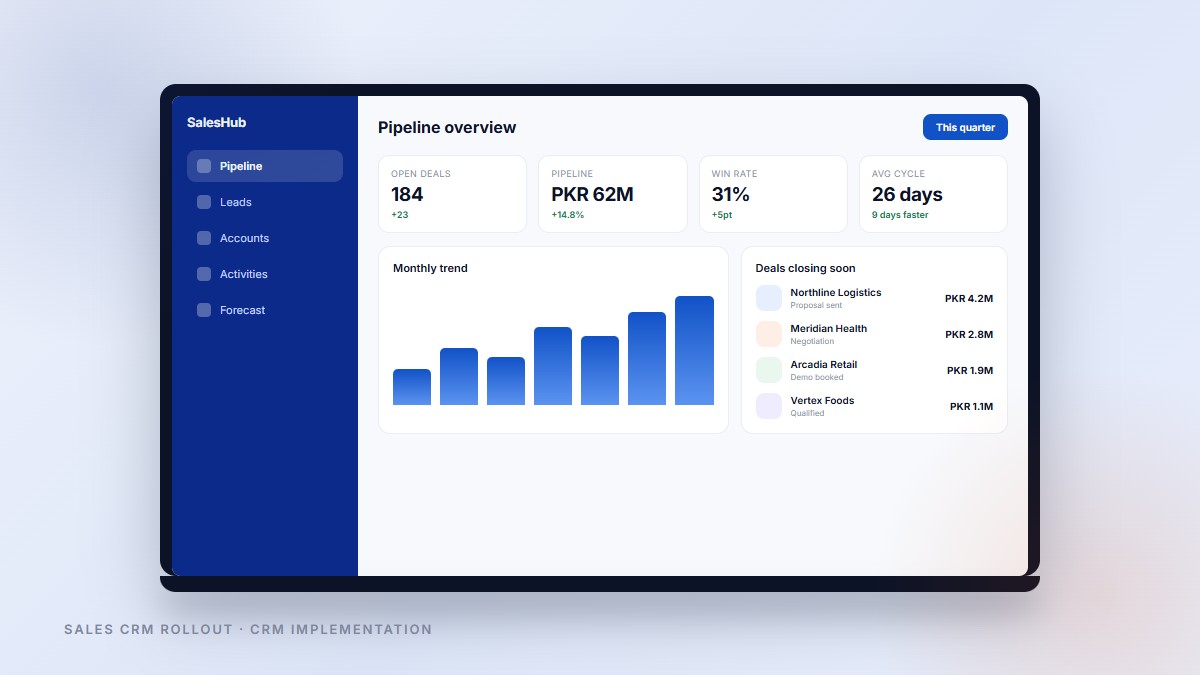
Leverage powerful data analytics within your CRM to gain actionable insights. We provide dashboards and reporting tools to monitor performance, identify trends, and make data-driven decisions.
Scalable Cloud-Based CRM
Deploy a cloud-based CRM that grows with your business. Our solutions offer flexibility, remote access, and robust security features to ensure your data is safe and accessible anytime, anywhere.
What is CRM implementation?
CRM implementation is setting a customer relationship platform up around the way your team actually sells and supports: the stages, the fields, the automation and the reports. 360 SynergyTech implements sales and marketing automation, customer support integration and analytics, on a platform such as Salesforce or HubSpot or on a custom build.
A CRM fails or succeeds on one thing: whether the sales team would use it if nobody made them. Rollouts stall when the system asks for work that does not help someone sell, so the stages, the fields and the automation are shaped around how your team already works before anything is configured.
The implementation itself covers the pipeline and its stages, the automation that removes retyping, the connection to support so a customer's history is in one place, and the reporting that makes pipeline and activity mean the same thing to sales, support and management. Whether that sits on a platform such as Salesforce or HubSpot, or on a system built for you, is a question of how unusual your process is. Connecting it to an ERP, a store or WhatsApp is system integration work, and the AI features teams now expect inside a CRM come from the same models covered on the generative AI page.
Data migration from spreadsheets or another CRM
Most of the risk in a CRM rollout is in the data that comes with it. Moving it badly is how a team loses trust in the new system in the first week, so the migration is treated as its own piece of work rather than a step at the end.
- Cleaning: Dead records, test rows and half-finished deals are identified before the move, not carried across and discovered later by a salesperson calling a company that no longer exists.
- De-duplication: The same customer usually exists several times across spreadsheets and the old system. Matching rules are agreed with you, applied, and the merges are reviewable rather than silent.
- Mapping: Every field in the old system is mapped to a field in the new one, or deliberately dropped. Anything that cannot be mapped is raised with you rather than guessed.
- Testing: The migration is run into a test environment first and checked against record counts and spot samples you pick, then run again for real once it matches.
Off-the-shelf CRM or a custom one?
Worth settling before anyone configures anything.
| Off-the-shelf CRM | Custom CRM | |
|---|---|---|
| What it is | A platform such as Salesforce or HubSpot, configured for you | A system built around your own sales process |
| Time to launch | Weeks | Months |
| Cost shape | Per user, per month, for as long as you use it | Build cost once, then hosting and maintenance |
| Whose process wins | Yours bends to the platform | The system follows yours |
| Best for | Common sales and support workflows | A process no platform supports, or very large user numbers |
How a project runs
Discovery call
A short call about what you are trying to change, what you already run, and what success would look like. No charge, and no obligation to go further.
Scope and estimate
We write down what the first phase covers and what it does not, and send a detailed estimate within 2-3 working days of that call.
Build in stages
Work is delivered in slices you can see and comment on, with your own data in it, rather than a single delivery at the end. You review each one.
Launch and support
Handover includes the documentation and access you need to run it yourself, and we stay available for the fixes and changes that come out of real use.
Frequently asked questions
Which CRM platforms do you work with?
- Salesforce and HubSpot, or a custom CRM where neither fits the way you sell. The comparison above is the question worth settling first.
Why do CRM rollouts fail?
- Almost always because the system asks the sales team for work that does not help them sell. The fix is to shape the stages and fields around how they already work, and to automate the rest rather than ask for it.
Can the CRM connect to our other systems?
- Yes. ERP, support tools and your online store are connected through system integration, so an order placed in your store shows up against the right customer record.
Can we automate the repetitive parts?
- Yes, through RPA and intelligent automation for the data entry and handover steps, which is usually where the hours go.
What reporting do we get?
- Pipeline, activity and customer analytics built on the data the platform already collects, set up so the numbers mean the same thing to sales, support and management.
How long does an implementation take?
- Small pieces of work take 3-6 weeks, mid-sized applications 2-4 months, and larger enterprise platforms 6 months or more. You get a timeline after the discovery call, not before it.
Projects we have delivered

Schedule Your Appointment
We are here to help you with experts, Mon - Fri: 09.00am - 10.00 pm PKT