Custom Order Manager
Project Overview
A made-to-measure garment passes through many hands before it reaches the customer, and every handover is a chance for a wrong measurement, a missed deadline or a missing piece. Custom Order Manager gives the business one place to run that chain: the owner enters each order once, and masters (head craftsmen on basic phones) see only their own orders, in the order the owner sets, with photo-approval checkpoints at every step.
Challenges
Shipments left incomplete (a missing item cost about $100 to re-ship each time). The most profitable order wasn't always worked first — the owner spent about three hours every Monday manually matching papers and dates, then chasing masters on WhatsApp. Quality checks happened over video calls and were missed. Measurements were copied by hand from a printed order onto a tailor slip, introducing copying errors. Masters could not read the owner's English notes. Forwarded screenshots leaked the real delivery date to outside workers, slowing work down.
Our Solution
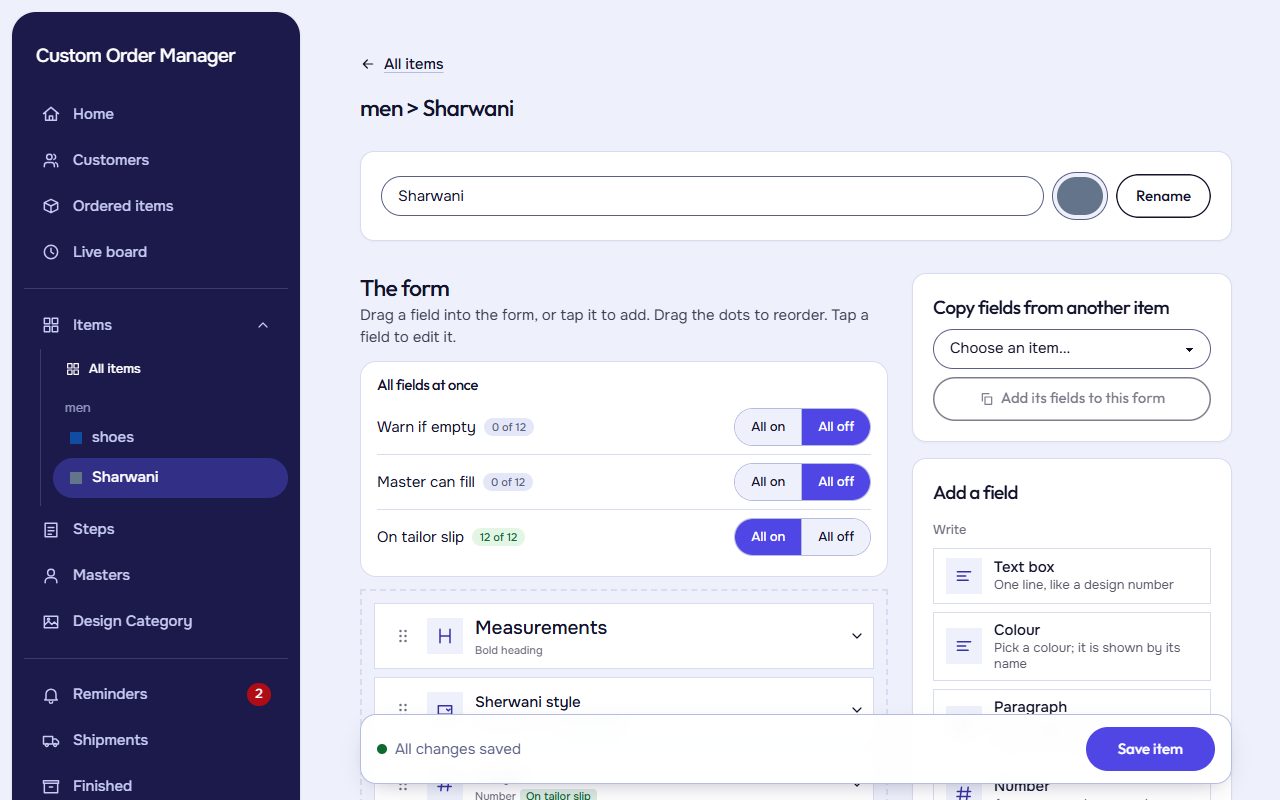
Finished items wait in a master's cart and are ticked off individually before a single send — an item with incomplete steps cannot be added. One priority list, controlled only by the owner, with a live production board on a TV. Each item type has its own steps, some requiring an owner-approved photo before the next step unlocks. One order sheet — identical on screen, in-browser and as a PDF — with a measurements grid and a cut-off tailor slip so nobody copies by hand. A language button and offline translator (Meta NLLB-200) show each master's screen in Urdu, Bengali or Hindi. Masters only ever see a karigar due date, never the owner's real delivery date, so a forwarded screenshot reveals no schedule.
Results
A shipment can only contain finished, ticked items, so a forgotten piece is caught before the box is closed. The owner checks one board instead of reconciling 22 papers, and masters cannot reorder the work themselves. Embroidery cannot move to stitching without an owner-approved photo, with every approval on record. The master prints one sheet and hands over a ready slip with no hand-copying. Each master reads the order in their own language at no ongoing translation cost. Screenshots can be shared freely without giving away the schedule. 159 automated tests (Vitest) plus Playwright browser checks; deployed on an Ubuntu machine at the client's office with HTTPS via Caddy/Let's Encrypt and nightly backups.
Project Summary
Next.js 16, TypeScript, Tailwind CSS 4, daisyUI 5, SQLite + Drizzle ORM, @react-pdf/renderer, @dnd-kit drag-and-drop form builder, offline translation (Meta NLLB-200, with Google Translate as a supported fallback), WhatsApp click-to-send links. No payment gateway — the app takes no payments. Security: hashed PINs, long random links, login lockout after repeated failed attempts, HTTPS, strict per-master data isolation. No formal compliance standard claimed.

Schedule Your Appointment
We are here to help you with experts, Mon - Fri: 09.00am - 10.00 pm PKT