Project Overview
Four engineering teams were each running their own data pipelines, on their own schedules, with no shared view of what ran when or what broke. Deployments were manual and took days. We consolidated everything onto a single orchestration platform with automated deployment, so a new pipeline goes from a merged pull request to running in production in minutes, and every run across every team is visible in one place.
Challenges
Pipelines were deployed by hand, which meant a deployment could take two days and often introduced differences between environments. Failures were discovered by whoever happened to look, usually hours after the fact and sometimes after bad data had already reached reports. There was no shared scheduling, so jobs competed for the same compute at the same time, and nobody could trace which pipeline produced which table.
Our Solution
We built infrastructure as code for the entire platform so environments are identical and reproducible, and wired deployment into the existing CI pipeline. Scheduling was moved onto one orchestrator with dependencies declared explicitly, so jobs wait for what they need rather than for the clock. Monitoring and alerting were added at the task level, with retries for the failures that are safe to retry and alerts for the ones that are not. Compute scales with the workload instead of running at peak size all night.
Results
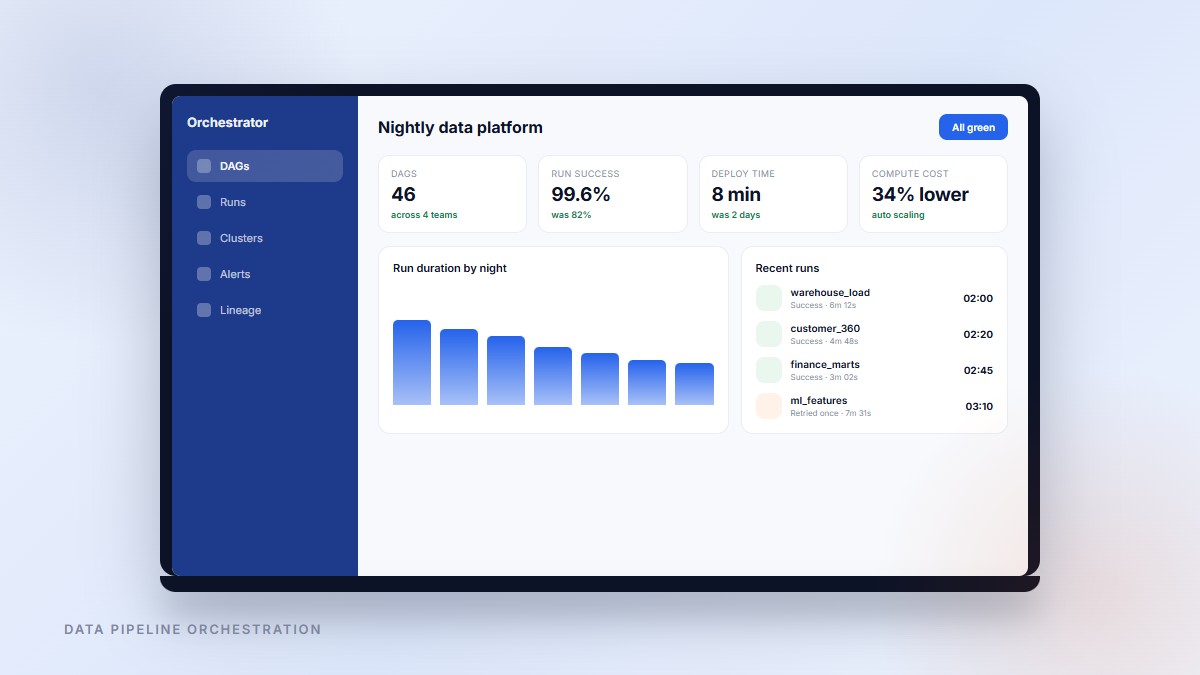
Deployment went from around two days to under ten minutes, run success rose from roughly eighty percent to over ninety nine, nightly processing finished about half an hour earlier, and compute costs fell by around a third now that clusters scale down when idle.
Project Summary
Four teams now ship pipelines on the same platform without stepping on each other, and failures surface within minutes rather than at the morning stand up. The platform has been handed over with runbooks and the client's own engineers deploy to it daily.